Mitigating bias in scholarship review processes
Welcome! We often get asked about scholarship processes, strategies, resources, rubrics, etc. from people inside and outside UW working hard to support students. Those requests, along with conversations with students and colleagues, highlight the deep “hidden curriculum” of scholarship processes and the potential negative impacts on students who could most benefit from the opportunities scholarships offer.
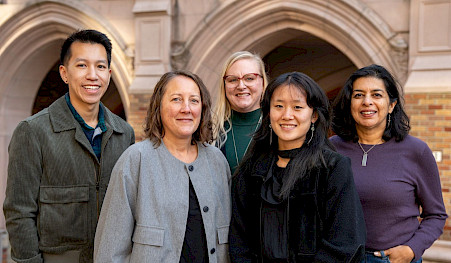
OMSFA team members are constantly working through each of the scholarship processes we play a role in to identify opportunities for increased transparency, clarity, and mitigation of biases. This is a work-in-progress, and we continue to learn along the way.
Every scholarship has a unique purpose, mission, history and goals that influence eligibility requirements, application materials, advertising strategies, applicants and selection committees. This collection of resources, strategies, and questions are simply considerations that might be helpful as you build new programs, rethink existing processes, and/or participate in reviewing applications.
Bias mitigation
Starting points
This is a work in progress
We are working intentionally to shift our own scholarship processes to be more transparent, inclusive, and to mitigate the impacts of biases. In our self-education, we have drawn perspectives and insights from colleagues, students, and scholarship programs large and small, at UW, locally, nationally, and internationally.
Humans do this work
Scholarship selection processes are ultimately very subjective, but our goal is to employ strategies and build tools to help level the playing field and promote inclusive, equitable application and selection processes with diverse participation to support students.
We all play a role
Stakeholders from scholars and applicants to reviewers, administrators and funders, are all involved, and have an opportunity to learn and implement more equitable scholarship processes.
Defining "equity"
For the purposes of these materials and our work with scholarships, we use the definition of equity shared in the College on the Environment’s Diversity, Equity and Inclusion Glossary: “The fair treatment, access, opportunity and advancement for all people, while at the same time striving to identify and eliminate barriers that prevent the full participation of some groups. The principle of equity acknowledges that there are historically underserved and underrepresented populations and that fairness regarding these unbalanced conditions is necessary to provide equal opportunities to all groups.”
Resources & Materials
De-biasing Review Processes
- Dr. Joyce Yen’s “De-biasing the evaluation process of in-person review panels for a postdoctoral fellowship” (Nature Astronomy, 2019)
- “Unconscious bias: Stereotypical hiring practices” TEDx talk by Gail Tolstoi-Miller
Understanding Power Dynamics
- “Common Behavioral Patterns that Perpetuate Power Relations of Domination” by Margo Adair & Sharon Howell, with William Aal
- "For some students, there are even disparities in recommendation letters" by EdSource (based on a study by Inside Higher Ed)
Understanding Biases
- Project Implicit’s Implicit Association Tests
- Stanford’s VMware Women’s Leadership Innovation Lab See Bias/Block Bias tools & resources
Recommendation Letter Resources
- Avoiding racial bias in letter of reference writing (University of California, Merced; shared through NAFA)
- Avoiding gender bias in reference writing (University of Arizona; shared through NAFA)
- Equitable Practices for Writing, Reading and Soliciting Letters of Recommendation (Equity in Graduate Education Resource Center, University of Southern California)
- Guidance for writing references for people with disabilities (opinion) (Michele Cooke, Inside Higher Education, Feb. 7, 2022)
Ideas & strategies for scholarship application reviewers
Thank you for serving on a scholarship selection committee! These tips and guidelines serve as general information to augment the specific instructions you may receive from your particular scholarship program. These guidelines also reflect the approach our office has developed over time in attempting to maximize student support and fairness in reviews.
While we have tried to pull together a wide range of helpful considerations, there are certainly important things we have missed and issues that go beyond the scope of what we can address here.
Strategies and tips for the review process
Rubrics & Reading
- Review the rubric before reviewing applications.
- Review applications with the rubric side-by-side.
- Review all application materials, looking for evidence of all the selection criteria in all parts of the application.
- Start with the written materials such as personal statements or short answer responses, to understand the applicant’s perspectives and context.
- Review CVs and/or transcripts.
- Using the review rubric, score each criteria, checking back with the application and the evidence you are finding.
Notes & Comments
- Write detailed notes that you would be willing to share with applicants directly (in case applicants make that request), making them as specific as possible about the evidence you are finding in the application materials.
- Be consistent in what you comment on (e.g. discuss engagement first, then academics, etc.), to more easily track differences in applications and changes in your own reviews. Note anything unique or memorable.
- Writing thorough and specific notes helps you to participate in any committee discussions, advocate for strong applicants, and can support scholarship advisors and applicants in feedback discussions, if feedback is offered.
Breaking up the batch
- Read no more than 5-6 applications in one sitting to reduce fatigue.
- Read applications in a random order or Z-A (vs. the typical A-Z).
- Read each application as if it was the first one.
- Do not compare content between applications.
Take a three-step approach:
- Read the selection criteria and the review rubric carefully. Skim all the applications to get a sense of the overall group.
- Carefully read each application and evaluate, taking detailed notes.
- Re-read applications where needed, to confirm details and to spot check for consistency.
Strategies for evaluating specific application components
Scholarship application essays
Each scholarship program will have its own essay prompts crafted to gather information from students in alignment with the scholarship’s selection criteria and mission. These essays help the reviewer gain an overall understanding of the applicant’s lived experience in the context of the scholarship’s goals.
Being cognizant of common biases that may impact the evaluation process, and relying most heavily on the review rubric provided, here are a few additional factors that generally make for strong essays.
Does the applicant:
- Answer all question(s) posed in the prompt?
- Make a connection between the mission of the scholarship (the activity or interest the scholarship seeks to support) and the applicant’s academic, career, personal interests and/or goals?
- Articulate how they plan to achieve those interests/goals and how the scholarship/activity will fit into that plan?
- Describe the decisions they have made, clarifying and reflecting on relevant past experiences with specificity and detail?
Letters of recommendation
Letters of recommendation could be coming from any source: faculty, community members, supervisors, mentors, etc. Stellar recommendation letters always stand out. It is harder to assess those in the middle of the pack.
As a reviewer, look for positive, meaningful comments and evaluate the letters according to the review rubric. Clarify, if needed, the instructions given to applicants and to letter writers for the scholarship you are reading, to avoid making assumptions and to avoid the influence of biases.
- Do the letters confirm what the student has said in their application?
- Do the letters provide context, giving specific examples or information about student’s characteristics and qualities?
- Is the letter specific to the student, or could it have been written for anyone?
- Do the letters answer questions raised by the application?
Letters of recommendation can be challenging for a number of reasons. If a letter is problematic, avoid holding that against the applicant. Can you glean any information relevant to the selection criteria from it?
Some specific challenging circumstances
What to do with poorly written letters?
The writers may or may not be strong writers in general or be most comfortable writing in English. They also may or may not have had adequate time to write or proofread. Please do not hold writers’ errors (wrong applicant or scholarship name, grammatical mistakes or typos) against the applicant. Attempt to read the letter for content, in alignment with the review rubric.
What to do with recommendations from the same author for multiple applicants that appear very similar, or actually are the very same letter?
This is no fault of the applicant and is likely more reflective of the harried writer. Attempt to read each letter on its own and consider the merits of each separately, in alignment with the review rubric.
What to do with specifically negative letters?
Unfortunately, from time to time, applicants do make errors in selecting their letter writers and this is born out in recommendation letters that are not “recommendations” at all and provide mostly negative comments.
Should this impact an otherwise strong application? No, the same questions provided above should be considered in this case. Consider if the writer says anything relevant to the application, and whether the letter provides evidence to back up the negative statements. The letter may say more about the author than the applicant.
See Bias Mitigation Ideas & Strategies for Scholarship Administrators/Managers section for additional considerations regarding recommendation letters.
Transcripts
Academic potential can be demonstrated in numerous ways; many research, scholarship and fellowship opportunities are no longer so focused on grades or GPA. However, transcripts are still included in most applications as one way of understanding the student’s academic potential.
In evaluating an applicant’s transcript with an eye towards equity, consider the following:
- Details and contexts shared that have impacted their studies
- Trajectory of the GPA – is the trend or pattern increasing? Consistent?
- Challenging periods – transitional years, changing majors, balancing school and work or family commitments and other examples that can result in quarter(s) where grades are inconsistent with the overall history of the transcript
- Acknowledgement of those challenging periods in other materials (including recommendation letters), with information to help you contextualize those grades
- Challenging course content; independent study/research credits the applicant has listed
- Credits the applicant has taken within the graded period
- Grades in major courses or courses relevant to their future goals
- Other achievements, engagements, commitments
Avoid sorting the applications by GPA before the review begins.
Note:
These guidelines are intended to supplement, not supplant individual scholarship instructions. Rather, they are strategies for reviewers to approach reviews fairly and mitigate common biases during the evaluation.
Ideas & strategies for scholarship administrators/managers
Process improvement is on-going and iterative! Scholarship Administrators/Managers are often responsible for reviewing, evaluating and updating scholarship applications, advertising and creating committee guidelines, along with other materials on a regular basis. While this can be time-consuming and hard to fit into already full workloads, it is an opportunity to increase transparency and inclusivity.
If you are building a scholarship process from scratch, you have every opportunity to infuse equity and inclusivity into the materials and processes. If you see changes needed for an application process already underway, you might need to make smaller changes to keep things fair for applicants during the current cycle and implement larger changes in the cycles to come. Either way, we encourage updating the materials at least every 2 years, if not every cycle.
Take the same advice we give students working on applications: start early, stay organized, chip away at each piece. Finally, try to have all stakeholders involved (could include donors, selectors, students, and other key partners) during the process improvement phase. Their input will help ensure buy-in and collaboration at all the stages of the scholarship process.
Opportunities for improving transparency of selection criteria
Crafting selection criteria is difficult and laden with opportunities for biases to negatively influence decisions. Collaborate with your team on drafting and revising selection criteria. Consider how common biases might creep into selection criteria creation, during the application review and final selection processes, and include notes for your selection committee to help mitigate these.
- Compare the selection criteria you are working on to the established program mission, goals, contract requirements, etc. Define terms used and considerations behind those terms so applicants and committee members can understand and apply them.
- While there is no perfect template, consider the temptation to use descriptors like “high achieving” or “academic excellence”. Those phrases are often used because they seem like the most concise wording, sometimes because we want to leave flexibility for applicants to bring their strengths in any form, but mostly they result in everyone involved assuming they mean GPA.
- Can you further define phrases like these so students know what they can do to demonstrate the qualities your program is looking to support? Can you help reviewers avoid the “I’ll know it when I see it” approach?
Many scholarships are created to honor a specific person or group of people (for example, the Paul & Daisy Soros Fellowship for New Americans). Consider how that history influences the selection criteria. Consider making as much of that information publicly available as possible, be transparent about how it influences the selection criteria, provide specific instructions for applicants and committee members about how to interpret and apply both the selection criteria and that contextual information.
Finalize and make the selection criteria public, transparent and accessible to applicants and selection committee members. Revisit them every cycle to ensure they:
- Continue to make sense and align with program goals
- Are reflected in the application materials you’re asking students to submit, particularly essay prompts and recommender prompts (if using)
- Are described clearly and consistently for selectors in the review rubric
Currently, many scholarship programs share their selection criteria publicly. Very few make their full scoring rubric public. Consider where there could be room to push those boundaries while also maintaining confidentiality where needed. Some examples:
- Seattle Public Library Foundation’s Stim Bullitt Civic Courage Scholarship program shares its essay judging rubric.
- National Science Foundation Graduate Research Fellowship Program shares reviewers’ notes with applicants to inform next applications, and a significant amount of reviewer information, including explanations of selection criteria, is publicly available.
Opportunities for maximizing inclusivity in eligibility requirements
- Review the scholarship contract annually to ensure your eligibility requirements continue to align, and that they continue to serve your goals for a diverse and inclusive applicant pool.
- Don’t require US citizenship or state residency if you don’t have to. This gives all students, including international students and undocumented students, the opportunity to apply. Students appreciate and are encouraged by seeing scholarships they are eligible to apply for, whether they actually end up applying or not.
- Don’t limit eligibility by GPA, even for scholarships intended to recognize “academic achievement” or requiring “academic merit”.
- Despite concerns about the potential number of applications we might receive, we tested this recently and found removing the previously used GPA minimum had no negative impacts on the quality, strength, or number of applications we received. Timing and individual student’s choices about workloads ultimately have a much bigger impact on application numbers and strength.
Opportunities for maximizing inclusivity in application materials
Rather than simply plugging in the usual application materials, consider what your selection committees really need to see and how applicants will benefit from including each piece of information. Do the application materials requested align with the selection criteria and strongly support applicants in highlighting how they meet the selection criteria?
Grades/GPA
Many scholarships have a selection criterion connected to academic or intellectual performance or potential. Course grades and GPA are often the default method of evaluating this, and yet those letter or numerical grades never give the full picture, nor do they end up being helpful in distinguishing among a sea of compelling candidates all with impressive grades.
If your program is looking to move away from over-reliance on GPA and grades in the selection process, consider:
- If academic merit, strengths or potential is a selection criterion, what other application elements could provide applicants the opportunity to demonstrate that? Consider all the ways academic potential can be demonstrated. Some examples: presentations at national conferences, recommendation letters highlighting achievements in a specific project or class, demonstrations of actively seeking out and utilizing resources and/or programs designed to increase access.
- Does the application benefit from inclusion of a transcript, or can the selection committee review applications without one? Enrollment can be verified by other means.
- Does the application ask students to list, or highlight, GPA in ways that give it more weight than it needs to have in the review process?
Example: We realized our application form, when presented to selection committee readers, defaulted to showing the transcript as the first among several pieces of information. The application form also asked students to report their GPA as one of the very first questions they answer. The cumulative effect was to over-emphasize in the selection process the numerical scoring of academic work in ways we did not intend, were not serving our goals for the program, nor were required by the endowment contract language of “demonstrated academic merit.”
If committees are asked to consider transcripts, provide guidance on what should and shouldn’t be the focus of that portion of the review.
Avoid sorting the applications by GPA before the review begins.
See the Bias Mitigation Ideas & Strategies for Scholarship Application Reviewers section on Transcripts for additional considerations.
Resume or CV
This is a critical part of any application, and one that students can either overlook easily (because they already have a resume they’ve used for job applications, for example) or don’t know what it is or what should be included (have never made or seen one and don’t know the jargon). What is the selection committee hoping to learn about their experiences from this document?
- Provide specific resources or guidance for applicants when asking for a resume or curriculum vitae (CV).
- UW resources: OMSFA CV writing resources, Career & Internship Center resources.
Considerations:
- One big benefit of asking for a resume and providing guidance: applicants are encouraged to create this application component, which they can and will use for other purposes and can continue to build upon. The development of a professional resume or CV is a tangible benefit regardless of the outcome of the scholarship selection process.
- Drawbacks to asking for a resume or CV: not everyone has one, knows what should be included, or how to craft a strong one for a scholarship application. Certain types of information, like family commitments/obligations that often account for time that would otherwise go toward other types of extracurricular experiences, would not traditionally be reflected on a resume.
- Would students be served better by being clear about what to include and asking them to plug that information into a form? This would standardize the information shared and reduce opportunities for applicants to mistakenly discount information that could benefit their application.
Essays
Reconsider any essay prompts and instructions regularly:
- Will students understand what information you’re seeking from them? Does that align with the committee’s expectations?
- Can you provide additional descriptions, questions, and information to help applicants flesh out their ideas more fully and bring their strongest applications to the table? Consider how those questions are phrased/organized in order to promote success of applicants in answering the questions fully?
- Consider carefully the challenge of providing opportunities for students to share information about contexts and experiences that have influenced and motivated their directions vs. questions that might suggest they are being asked to “trauma dump”. For many reasons, it is very common for applicants to make this assumption no matter how carefully worded a prompt might be.
- Many applications include questions along the lines of “what challenges have you faced…” Is there additional context that could help students understand why they are being asked that question? What is the selection committee hoping to learn from an applicant’s response? Many students have needed to overcome many challenges in their lives. Can additional instructions help them to understand in what ways any of those experiences are relevant to your selection process?
Examples of prompts that attempt to provide some context:
The Goldwater Scholarship application includes, after responses about research interests, experiences and future goals, an optional question: “Optional question, answering the question below will depend on your personal experience. Goldwater Scholars will be representative of the diverse economic, ethnic and occupational backgrounds of families in the United States. Describe any social and/or economic impacts you have encountered that have influenced your education – either positively or negatively – and how you have dealt with them.”
The Udall Foundation Undergraduate Scholarship application includes, at the end of its application after several other essays addressing leadership and career interests, an optional short response: “Alert the Foundation to any unusual circumstances or hardship. Examples include situations that may have affected your academic performance or limited your activities.”
Recommendation Letters
Debate continues about this traditional application component (for an introduction to the debate, search the Chronicle of Higher Education for “letters of recommendation”). Consider what information the selection committee really needs from recommenders. If you and your team are finding letters of recommendation are not contributing meaningful information, are unduly burdensome, or perpetuate inequities for applicants, consider:
- Many scholarships do not ask for letters for recommendation (e.g. Gilman Scholarship)
- If desired, would a recommendation form with specific guidance/questions better support recommenders in providing relevant information and reviewers in their evaluation? Examples:
- Fulbright ETA Recommendation Form
- Truman Scholarship Recommendation Request Form
- Sample very basic outline of a potential recommendation form that can be tailored
What expectations does your selection committee have about who is best positioned to provide the information they’re seeking from recommendations. For example:
- Is there an unwritten expectation that academic references are preferred over non-academic references?
- That letters from faculty are preferred over letters from TAs?
- Is that expectation something that should be reconsidered?
- If not, is it made clear to applicants and recommenders?
Opportunities for maximizing outreach
To expand the pool of applicants for any scholarship, more students need to hear about the scholarship and feel confident they can both meet the eligibility requirements and see themselves in the selection criteria and past awardees.
Maximizing outreach efforts, especially by building intentional collaborations with units across campus, specifically encouraging applications from students from underrepresented backgrounds and marginalized communities, providing connections to or sharing reflections from past awardees, and creating welcoming environments (on websites, social media, on zoom, at workshops and in 1-1 meetings, etc.) are all opportunities to establish an inclusive scholarship culture.
Consider the language used in sharing information about a scholarship with different audiences. Relying on the endowment contract verbiage can help with consistency but may not help students understand what the program is about or what they need to do to apply strongly.
Share opportunities widely through both broad-based announcements and to specific collaborators who interface directly with student populations:
- We ask applicants how they’ve heard about the scholarships we manage. Most responses indicate word-of-mouth, from a trusted advisor, mentor or friend. A much smaller number indicates internet searches or various databases.
- Specific encouragement from trusted supervisors, advisors, faculty members for individual students has the biggest impact on applicants’ confidence to apply.
- But many compelling applicants do not have that social/academic capital, so broadcasting widely is essential to ensure access.
UW’s communications team has collected helpful guides for Communicating with an Equity Lens
Opportunities for maximizing inclusivity in the review process
A review rubric helps reviewers align their comments and score to the selection criteria, maintain consistency throughout their reviews and reduced the temptation to bring in outside information. If made public, review rubrics could be useful tools to improve transparency and change applicant pools, as more students understand what is expected and how their applications will be reviewed.
Review Rubrics
- What? An evaluation system matched to the selection criteria.
- Why? Establish consistency across reviewers and reduce the temptation to bring outside information into the review process.
- How? Specifies and details strengths in an application, to measure the degree to which the selection criteria are met. Sometimes a numeric rating scale with room for comments but can also be just comments and notes.
To be most useful and transparent, rubrics could be shared with applicants to help them understand the selection criteria and how their applications will be reviewed. Examples of programs that share selection criteria in different ways: Mary Gates Endowment for Students, National Science Foundation Graduate Research Fellowship Program, Truman Scholarship.
Common biases in scholarship selection processes
We all have biases that show up in all areas of our lives and for variety of reasons. These are but a few examples of biases that frequently appear in scholarship selection processes. Being aware of how, when, where and why these show up for each of us as reviewers, we can individually take steps to mitigate their impact on our reviews, and committees can reduce their impact on scholarship award decisions.
Types of Biases & Mitigation Strategies
Language
English is not the first language for many scholarship applicants. Nor are most scholarships intended to operate as essay contests (though some explicitly are). An essay-based application ultimately puts English language learners at a disadvantage.
Mitigation strategies
Focus on content and information provided and how that fits with the selection criteria. Ignore spelling, grammar and other mechanics unless specifically included in selection criteria.
If writing skill is considered a demonstration of academic merit or otherwise important, make that transparent for applicants and reviewers.
Halo Effect or Harshness/Horn Effect
Occurs when reviewers evaluate an applicant positively (halo) or negatively (horn) based on a single characteristic. For example, biases for or against certain programs, schools, mentors, etc. can influence scores.
Mitigation strategies
Rely on the review rubric and weighting provided. Check that you are applying the appropriate weight to each selection criterion.
Extracurricular
Certain activities are impressive. We may have previous experience and/or a preconceived opinion on the activities presented that may influence our review of the application. Are the extracurricular activities relevant to the selection criteria for the scholarship?
Mitigation strategies
Identify the evidence provided in the application materials. What has the applicant actually shared about it vs. your own knowledge/feelings about it.
Average/Central Tendency
Most of us tend to end up with a big group of applications that land in the middle of the pack of our reviews, making final decisions extremely difficult.
Mitigation strategies
Use the full range of scoring and take careful notes to help clarify and confirm that the hairs you are splitting stay aligned with the selection criteria.
Contrast
Occurs when reviewers compare applicants to each other or compare all applicants to a single applicant. For example, if one applicant is particularly weak, others may appear to be more qualified than they really are.
Mitigation strategies
Although comparison is a natural instinct, and sometimes final decisions do come down to direct comparisons, during individual reviews, it is important to try to evaluate each applicant on the content and quality of their individual application.
Noise
Occurs when applicants answer questions based on information they think will result in them getting a scholarship – what they think the reviewer wants to hear. A particularly tough example of this is the application that shares highly personal traumatic details that can be very compelling but may not be well-connected to the selection criteria at first glance.
Mitigation strategies
Cut through that noise by focusing on what evidence you can discern that connects to the selection criteria.
First Impression
Happens regularly when we are short on time and reviewing quickly.
Mitigation strategies
Consider the entirely of materials presented by the applicant. Consider revisiting applications more than once.
Gut Feeling
Reliance on an intuitive feeling that the applicant is worthy (or not) of receiving a scholarship without connecting evidence of the individual’s qualifications to the selection criteria.
Mitigation strategies
Use the review rubric. Identify the evidence provided in the application materials. Take specific notes about where you are seeing that evidence. If your gut feeling was actually not justified, rescore based on those careful notes.
Leniency
Occurs when reviewers tend to go easy on an applicant and give a higher rating than warranted, justifying it with a rationalization. It is very common for reviewers to start out more lenient and get stricter (or vice versa) when working their way through a large group of applications.
Mitigation strategies
Pay attention to how your approach to applications and scoring might be changing over the duration of your reviews, as a result of stress, interruptions, fatigue, etc. Take breaks! Take time to re-review those applications you read early on or at the end. Take time to re-review applications you’ve scored similarly (e.g. every application with a score of 2) to see if they seem consistent. Rescore if needed. Check that your notes connect to evidence provided in the application materials.
Negative Emphasis
Occurs when the reviewer allows a small amount of negative information to outweigh positive information. This can particularly show up when reviewing recommendation letters.
Mitigation strategies
Consider again the selection criteria and the weighting provided in the review rubric. Diligently note positive connections along with the negative information.
Recency
Occurs when reviewers recall the most recently reviewed applicants more clearly than earlier applicants and their evaluation is skewed as a result. Particularly common when reading many applications over a long period.
Mitigation strategies
Consider revisiting applications in small batches and taking thorough, consistent notes.
Similar-to-Me
Occurs when reviewers share interests, experiences or other characteristics with those expressed by an applicant, causing reviewers to bring in their own knowledge/assumptions, to score them more favorably, or to overlook other elements that don’t align with the criteria. For example, a reviewer with an interest in music might rate an applicant who shares that interest more positively – even if an interest in music is not one of the scholarship criteria.
Mitigation strategies
Identify the evidence provided in the application materials. What has the applicant actually shared about it vs. my own knowledge/feelings about it? How does that connect with the selection criteria?
Stereotyping
Occurs when reviewers assume an applicant has specific traits because they are a member of a group. Membership in many types of groups – cultural, racial, economic, political, academic, religious, and more – may be disclosed in the student’s application.
Mitigation strategies
Identify the evidence provided in the application materials. What has the applicant actually shared vs. assumptions I am making?
UW selection committees should give no consideration to an applicant’s race, color, creed, religion, national origin, citizenship, sex, pregnancy, age, marital status, sexual orientation, gender identity or expression, genetic information, disability, or veteran status.
Acknowledgements: This work was partially supported by the UW Diversity and Inclusion Seed Grant Program (awarded Fall 2021) and undertaken as a collaboration between current and former team members from the Office of Merit Scholarships, Fellowships & Awards and the Mary Gates Endowment for Students. We benefitted greatly from consulting with Kyana Wheeler, along with colleagues and students across UW (Angelica Amezcua, Ruby Barone, Zoe Chau, Robyn Davis, Nell Gross, Sophie Pierszalowski, Sala Sataraka, Michelle Sutton), and members of the National Association of Fellowships Advisors (NAFA), who provided valuable input, insights, and resources.
Have resources or expertise you'd like to contribute? Please reach out!
Interested in our mission and values that inform the perspective we’re sharing here? Learn more about OMSFA.