Shubham Bansal
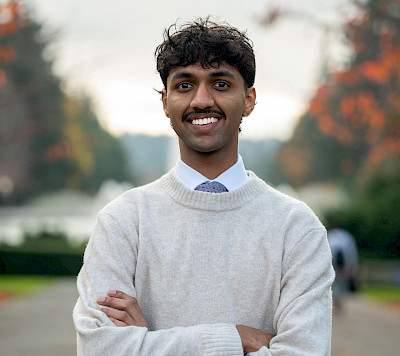
Shubham Bansal, of Mukilteo, Washington, is a senior at the University of Washington, where he is studying Neuroscience and Anthropology. He is the founder and Director of Narcare, a community-based nonprofit that distributes life-saving medication, trains community responders, and advocates for policies expanding overdose prevention across the US. As a researcher in the Linsley Lab, Shubham has published work on T-cell receptor repertoires in SARS-CoV-2 and autoimmunity, and at Seattle Children’s Research Institute he analyzes behavioral data to better understand emotional regulation in autistic youth. Outside of academics, he enjoys bouldering and going for runs. In the future, he aims to connect scientific evidence and community voices to build comprehensive health policies and programs surrounding substance use disorder. To that end, he hopes to pursue the MSc in Health Service Improvement and Evaluation followed by the Master of Public Policy at the University of Oxford.
Goals
Near term, I hope to study Health Service Improvement and Evaluation and Public Policy at Oxford while continuing to grow Narcare’s work in overdose prevention and treatment linkage. Longer term, I plan to train as a physician in addiction medicine and work at the intersection of clinical care and health policy by helping to design and evaluate programs that reduce SUD and expand access to evidence-based treatment.
Tips
My biggest piece of advice is: do not pre-reject yourself. It is very easy to look at past scholars or the statistics and decide you are not “that kind of person.” Apply anyway. These processes are less about being a finished product and more about being honest about what you care about, what you have actually done, and how you hope to grow. Treat the application as an excuse to pause and reflect, not as a test you either pass or fail. Talk through your story with friends and mentors. Write messy drafts. Let people who know you well push you to be specific and concrete rather than simply impressive. The strongest parts of my own application came from work that felt natural and necessary in my life, not from things I picked because they “sounded good.” Practically, start early, lean on campus advisors, and say yes to mock interviews even if they feel uncomfortable. Read a bit more widely about the world than you usually do, but do not try to reinvent yourself for a selection committee. If you go into the process seeing it as a chance to learn about yourself, connect with supportive people, and meet other applicants who care deeply about their communities, it will be worthwhile regardless of the outcome. And you might be pleasantly surprised by where it takes you.